What “Faral” is solving at Diwali
In a Maharashtrian Diwali context, Faral brings several sweet and savoury preparations together for household sharing, visitors and gifting. The practical task is not to reproduce one fixed master list. It is to create a spread that suits the people, time available, storage conditions and journey.
Use food roles instead of chasing quantity
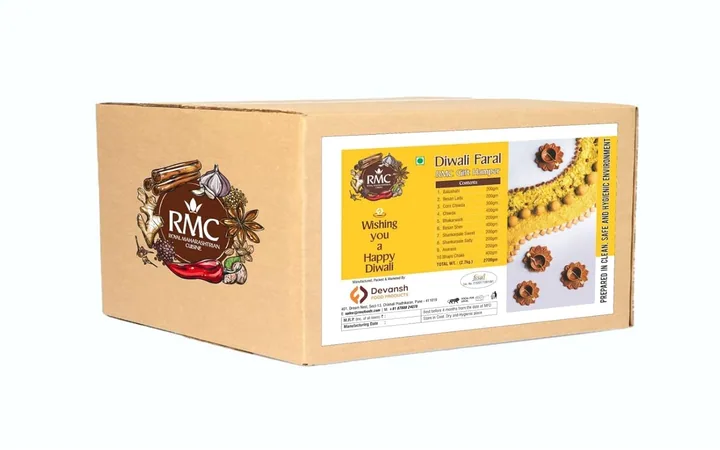
A clear spread can be planned in roles: a spiral or rolled savoury such as chakli or bhakarwadi; a lighter mixture such as chiwda; a crisp small-format item such as shankarpale; a filled sweet such as karanji; and a richer sweet such as ladoo. RMC’s recovered catalogue also represented anarase, balushahi and shev. Families and producers use different recipes, spellings and selections.
Worked household example
Consider six adults meeting once, with a preference for savoury snacks and one long road journey before serving. A practical shortlist might prioritise two savouries, one lighter mixture and two sweets, packed in sealed inner units. That offers contrast without making every guest sample ten items. If the same food is intended for repeated serving over a week, quantity, resealing and label dates become more important than maximum variety.
Check labels and uncertainty
Traditional names do not prove an ingredient list. Chakli recipes can use different flour blends; sweets may contain milk or nuts; production environments may create cross-contact concerns. FSSAI labelling requirements cover declarations including ingredients, allergens, net quantity and date/storage information for applicable pre-packaged foods. Use the current pack as the product-specific source.
Health context without moralising festive food
Faral is celebration food, but portion, frequency and the rest of the meal still matter. ICMR-NIN’s 2024 dietary guidance emphasises dietary diversity and limiting foods high in fat, sugar or salt. That does not require treating every traditional item as forbidden. A more useful editorial judgment is to serve deliberate portions, keep water and regular meals in view, and avoid using “homemade” as an automatic nutrition claim.
Conclusion
A strong Faral spread is culturally recognisable, varied enough for the household, and transparent about what is inside. Start with roles and recipients, then verify the actual product label and journey.
Sources
- FSSAI Labelling and Display Regulations compendium, checked 2026-09-23
- ICMR-NIN Dietary Guidelines for Indians 2024
- Recovered RMC catalogue and first-party item images.
A planning checklist for the final twenty-four hours
Before the food is served, separate items that need different handling, retain the labels, and avoid decanting everything into unmarked containers if allergy or date information may be needed later. Put out a smaller serving quantity and replenish it rather than leaving the full stock exposed for a long period. If food has travelled, inspect seals and condition before presentation. These steps are practical controls, not a claim that one storage method fits every recipe.
What would make this guide insufficient?
This guide cannot resolve an individual product’s ingredients, a household’s allergy risk, a current RMC price or the condition of a delivered pack. Those questions require the actual label, written seller information and inspection. The guide is successful when it helps a buyer ask better questions and avoid equating tradition with a fixed formula.
Editorial disclosure: this guide may support product enquiries, but it is written to remain useful without a purchase. No medical, certification, availability or delivery claim is inferred.